About
Seventy years of the same argument
Motorsport is not a marketing department here. It is the development process. What survives a race weekend gets built for the road, and what does not, does not — which is why a GT car reads as under-decorated next to its competitors and outlasts all of them on a circuit.
The company
Porsche, in brief
- 1931 — Stuttgart
- Ferdinand Porsche opens an engineering consultancy that designs cars for other manufacturers for seventeen years before building one under its own name.
- 1948 — the 356
- The first car to carry the Porsche name is hand-built in Gmünd, Austria — fewer than fifty are made there before production moves to Stuttgart.
- Zuffenhausen
- Every 911 built since 1963 has come off the same production site in this Stuttgart district, now alongside the Taycan.
- Still family-controlled
- More than nine decades on, the Porsche and Piëch families hold the majority voting stake, through Porsche SE.
- Le Mans
- More outright victories at the 24 Hours of Le Mans than any other manufacturer in the race’s history.
Weissach
Developed against a lap time
- 1953
The track came first
The 550 Spyder was not a road car adapted for competition. It was a competition car that happened to be street legal, and that order of operations has never been reversed. Every GT model since has been developed against a lap time before it was ever developed against a brochure.
- 1973
Built because the rules demanded it
The Carrera RS 2.7 existed to satisfy a homologation requirement: build enough road cars and you may race the design. That constraint produced a ducktail, a thinner shell, and a car people are still arguing about fifty years later. Regulation, handled properly, is a design brief.
- 1999
Response over pressure
Forced induction is the efficient way to make power. It is not the honest way to deliver it. A naturally aspirated engine answers the throttle at the crankshaft rather than at a plenum full of stored boost, and the GT3 has kept that connection through four generations while almost everything else in the range gave it up.
- 2003
Subtraction is the expensive part
Adding power is cheap; removing mass is not. The Carrera GT put a carbon monocoque under a road car and established the terms every RS has worked to since — that a kilogram removed from an unsprung corner is worth more than a kilogram removed anywhere else, and that carbon fibre earns its cost only where it changes how the car behaves rather than how it photographs.
- 2022
Speed is what you can carry
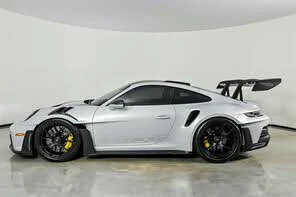
The 992 GT3 RS makes 860 kilograms of downforce at 285 km/h — double the 992 GT3. Straight-line figures are a marketing convenience; the interesting number is how much speed survives a corner. That is an aerodynamics problem, and it is the one this car was built to answer.
- 2022
The first Porsche that can stall its own wing
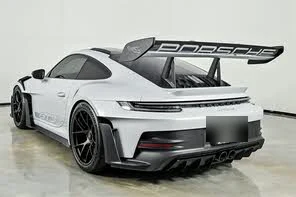
A drag reduction system had never been fitted to a production Porsche before this car. Both the front elements and the two-part rear wing flatten on command inside a defined speed and load window, trading downforce for terminal velocity on a straight and giving it back under braking. It is the clearest statement of the whole RS argument: aerodynamics are not a fixed shape but an adjustable variable, and the driver gets the switch.
The Weissach package
Fifteen kilograms, itemised
An option that adds nothing. Every line below removes mass from a place where mass costs lap time — rotating, unsprung, or high in the car — and the total is roughly fifteen kilograms off a 1,450 kg kerb weight.
Carbon-weave body
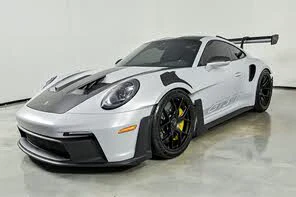
Front lid, roof, the upper shells of the exterior mirrors and parts of the rear wing are finished in exposed carbon weave. The finish is a consequence of the material choice, not the reason for it.
CFRP anti-roll bars
Front and rear anti-roll bars, the rear coupling rods and the shear panel on the rear axle are carbon-fibre reinforced plastic. Stiffness held constant, mass removed — and removed from the parts of the car that have to change direction.
Forged magnesium wheels
Centre-lock forged magnesium in place of aluminium, eight kilograms lighter across the four corners. Unsprung and rotating mass, which is the most expensive kind to carry and the most valuable kind to remove.
Titanium roll cage
A bolt-in titanium half-cage weighing roughly ten kilograms less than the steel equivalent, alongside carbon shift paddles with magnetic-pulse actuation for a firmer, shorter throw.
Nomenclature
What the badges mean
- RS
- Rennsport. The suffix marks a car developed against a circuit rather than a brochure, historically to satisfy a homologation requirement.
- GT3
- Named for the FIA class the road car underwrites. Naturally aspirated, rear-wheel drive, and built around the same 4.0-litre flat-six architecture that races.
- DRS
- Drag Reduction System. Flattens the front elements and rear wing inside a defined window to trade downforce for straight-line speed.
- PDK
- Porsche Doppelkupplung. A seven-speed dual-clutch transmission with shorter gearing than the GT3 and no manual alternative offered.
- PCCB
- Porsche Ceramic Composite Brake. Optional 410 mm ceramic front discs in place of the standard 408 mm steel, saving roughly half the rotating brake mass.
- Weissach
- Porsche’s development centre in Baden-Württemberg, and by extension the option package that applies its priorities to a production car.